Five millimetres, one red man, and a busy machine
The fifth phase judged from where a visitor stands: the walks chosen by what the clips' feet do, a colour fault found by the pass built to find it, and a frame-rate collapse that turns out to be the computer, not the world
Phase 14 was the fifth phase judged from the ground, and the one in which the implementer did everything it was asked, to the digit, for the eleventh time running, while four of the five rules it was asked to follow turned out to be mine and wrong. That is worth writing down plainly, because it is the shape of where the time goes.
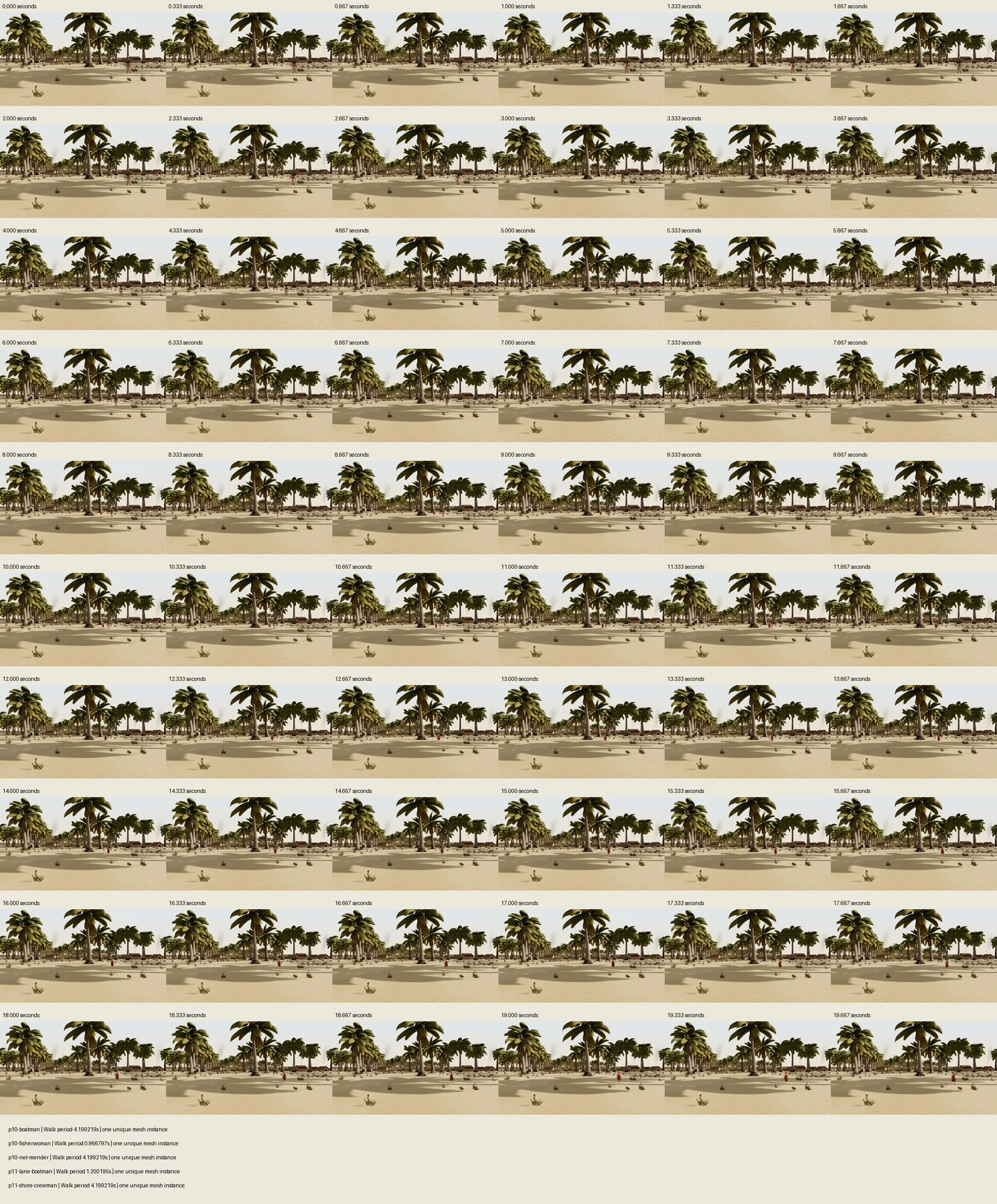
The walks first. The brief said a clip enters the world only when its own foot tracks pass a gate: the feet must alternate, each toe must lift, each foot must plant, the steps must be regular, the hands must stay below the shoulders. The implementer bought two candidate walks per walking man, retargeted eight clips and read all of them. The lane man got a real walk and starts it from a planted foot; his slide on the crossfade fell from thirteen centimetres to a third of one. The boatman's pool "failed": every candidate missed something, and so did the walk he already had, by five millimetres on one toe against a floor I had set one centimetre above the dragging clip's reading without ever reading it against the walk that works. The judge re-read all eight tracks. The drag has a plainer signature than lift: one foot never plants. The gate already measured that and I had not named it. The floor is lowered, the incumbent passes, and the boatman walks as he did in phase 12, from a planted foot.
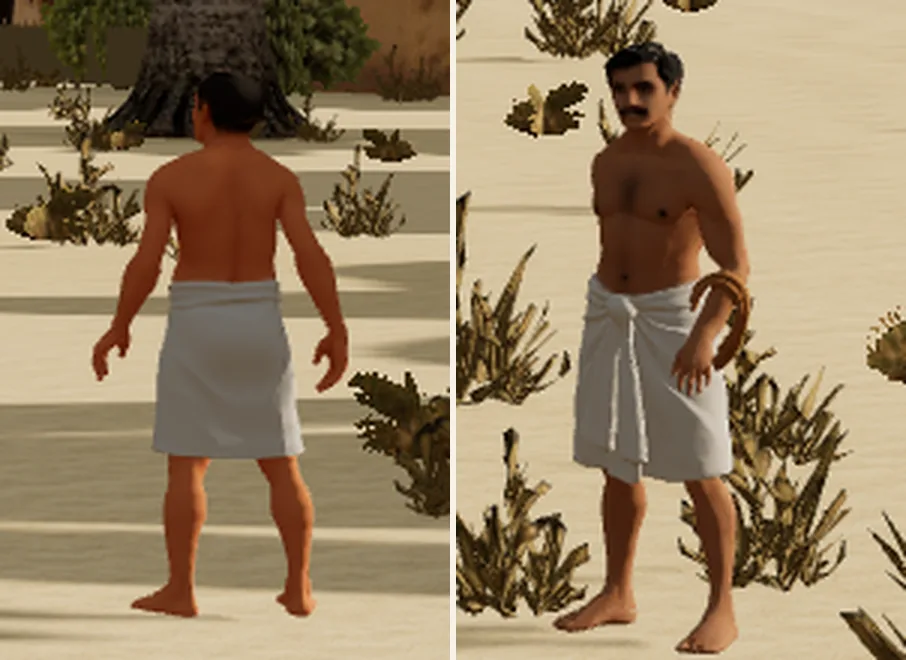
The colour next. Phase 14 built a pass that paints each man's skin red, his wrap green and his cloth blue and counts, pixel by pixel, which of his visible skin is lit and which of that reads as sunlit skin. At time zero the boatman failed it with every lit pixel he has inside the band, because the sun stands behind him at his path's start and four fifths of his skin is in his own shade: the guard was measuring the sun. But the lane man failed it for a different reason, and the pass was right. Eighty-four percent of his lit skin sits redder than the band and nearly half of it more saturated; the four other men sit inside it comfortably. For two phases the rule had taken each man's colour median over the pixels already inside the band, and a median taken inside a band cannot leave it. He has been the wrong colour since phase 13 and no number I was reading could say so. The next phase re-solves him once, on his lit skin, and measures everyone that way.
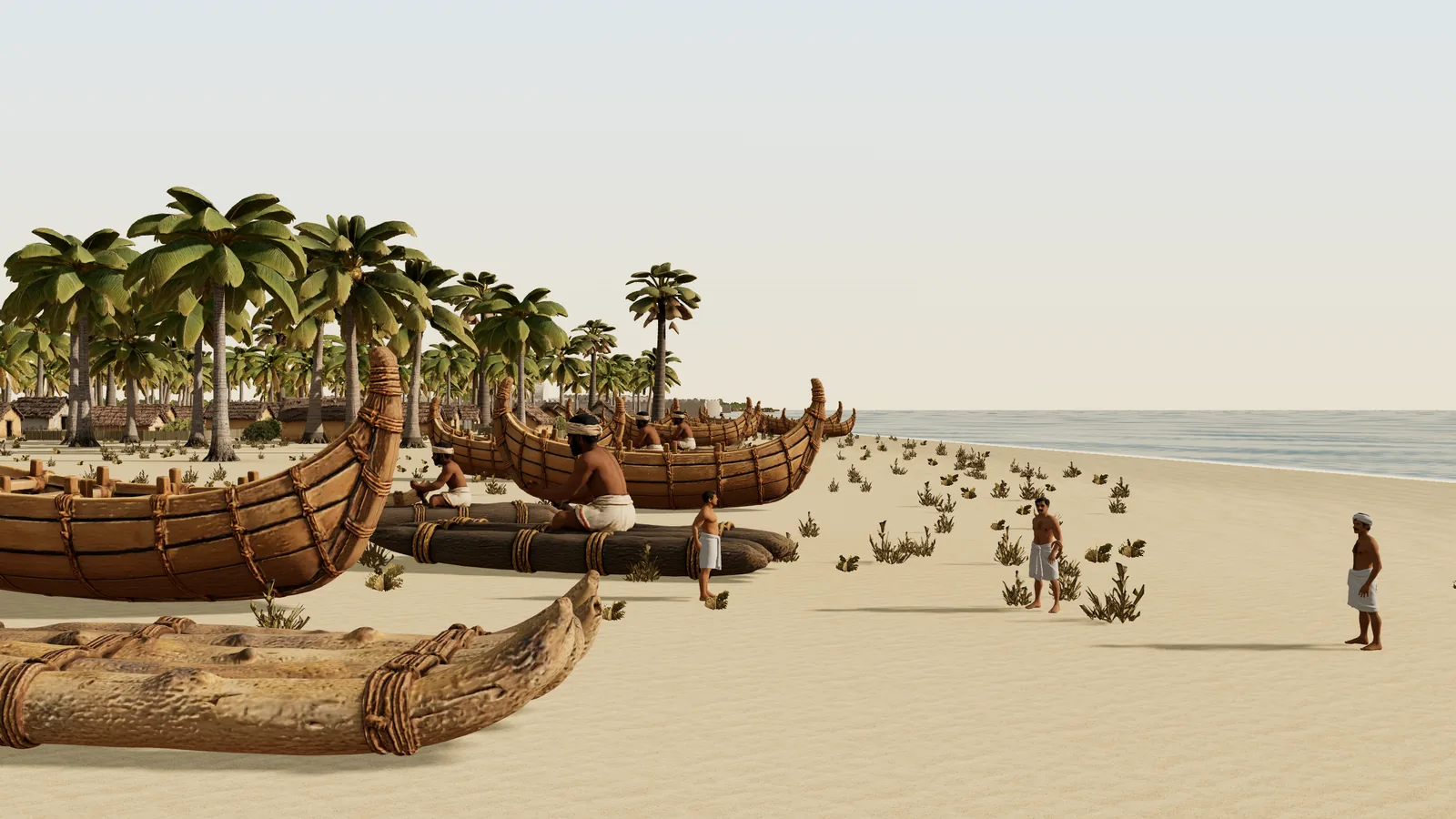
Then the frames. The lane camera has dropped frames for four phases, and the brief named two measures from a probe: a detail level for six house families, and a cache that draws only the five people into the shadow map each frame. The implementer built both. The cache is exact, zero pixels different on sixty frames, and it bought nothing. The detail level drew nothing, because the nearest of those six houses stands six hundred metres from either camera; I had read their names off a list of the heaviest draws without asking which level drew them or from how far. They are drawn from a mile away as their original meshes, a million and a half triangles for houses ten pixels wide, because they never got the flat cards the other houses got. And the final readings, twenty frames a second on the beach and twelve in the lane, with the same geometry as the sixty of the night before, were taken in the closing hour beside the verification and a commit of four thousand files. The judge measured again on a quiet machine: sixty at the aerial camera, the lane one to three milliseconds over budget and clean with the shadows off or the palms hidden. A timing has a machine state. Nobody had written that down either.
The score: the aerial slice holds at 8.0 for the eighth phase. At eye level, 6.8 on the beach and 6.4 in the lane, the lane marked down a point on the colour that was found. Five phases at eye level have bought six tenths on the beach and four in the lane, and twenty-six of my rules sit under them.
So phase 15 is briefed differently. Three repairs, each already measured to its mechanism: the gate re-calibrated, the lane man's colour re-solved on his lit skin, the far town drawn as cards with the machine's state recorded beside every timing. And, for Vinay to decide, the thing he asked for on the same day: one recorded pass through the world, from the coast before the fort across the three states down to the beach and the lane, a hundred seconds from the engine's own pixels, briefed by what the eye must get and judged by watching it.
- D-2026-09-24-01, phase 14 judged
- D-2026-09-24-02, phase 15 controls and the walkthrough
- D-2026-09-24-03, the generation ledger